
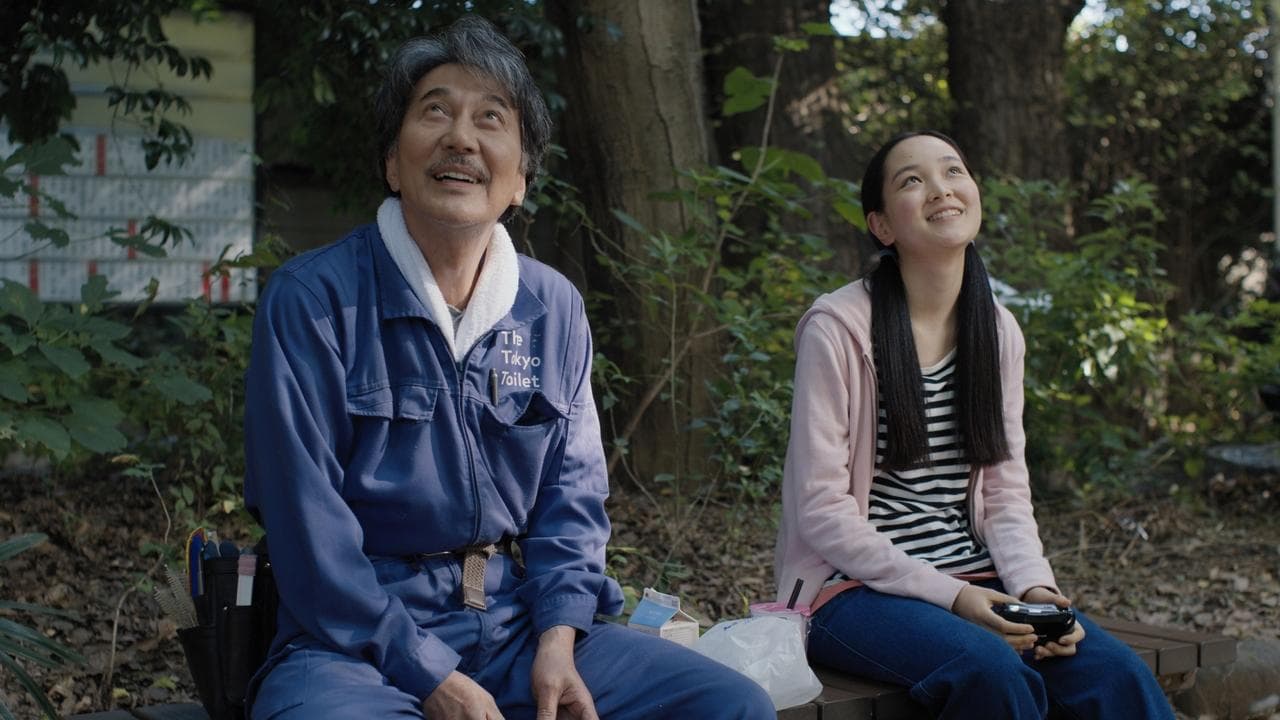
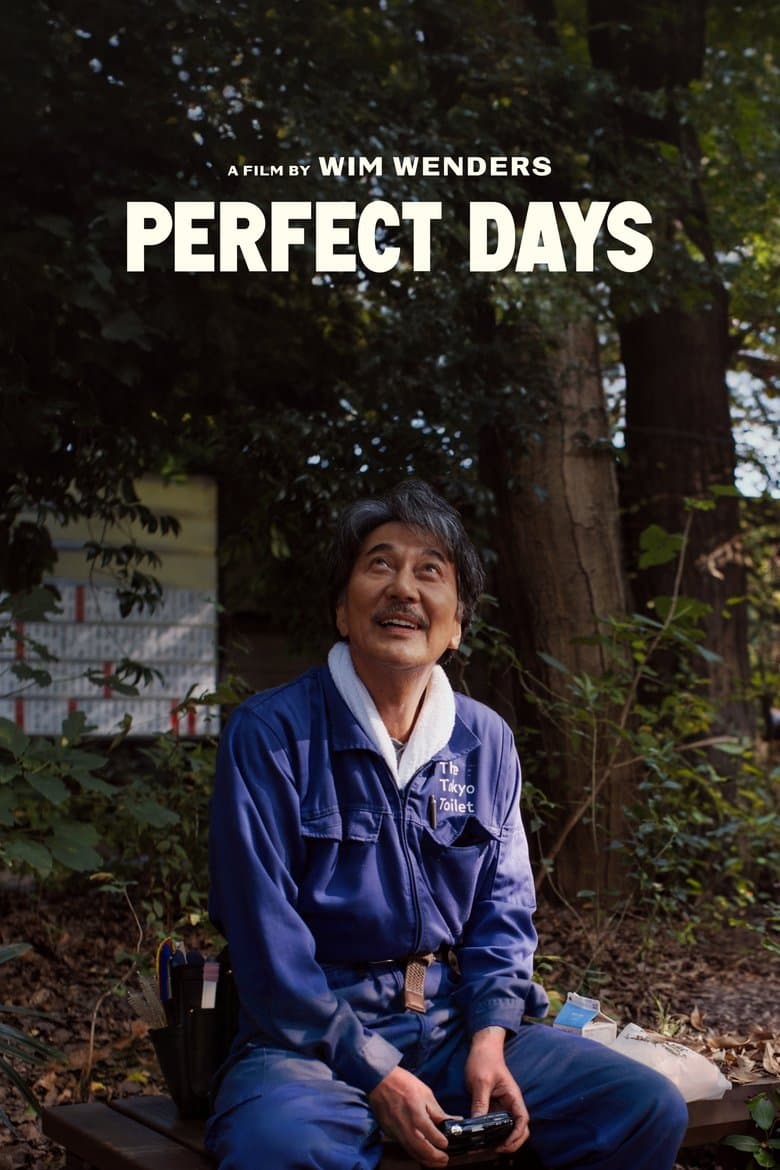
Perfect Days
Wim Wenders returns to his Tokyo beat for a quiet, observational masterpiece anchored by one of the most generous lead performances of the decade.
Wim Wenders
Dec 22, 2023
Quick Verdict
“A film made of looking. Kōji Yakusho won Cannes's Best Actor for good reason, and Wenders sustains a tonal control most directors half his age cannot approach.”
Plot Summary
Hirayama is a middle-aged man who cleans public toilets across Tokyo's Shibuya district. He wakes before dawn, listens to cassette tapes on his morning drive, tends to tiny plants, and reads Faulkner in bed. A series of small interruptions — a runaway niece, a karaoke singer, a terminal stranger — briefly unsettle a life he has carefully arranged around attention itself.
Full Breakdown
A film that takes 'slice of life' as a formal commitment
Perfect Days is structured as a week of near-identical days with tiny, significant variations. Wenders and co-writer Takuma Takasaki trust that repetition — rather than plot — is what makes the viewer notice change when it finally arrives.
The film's miraculous tonal register is that it never sentimentalizes Hirayama's job. The work is shown as actual, skilled, physical labor. The dignity is not announced; it is demonstrated shot by shot.
Kōji Yakusho performs an entire interior life through attention
Yakusho has about twenty lines of dialogue. Most of the performance lives in how he looks at things — a sapling, a cassette tape, a stranger on a bench. It is one of the decade's great silent-register leads, and it earned him the Cannes prize with no contest.
The final four-minute close-up, set to Nina Simone's 'Feeling Good,' is the single most moving shot of 2023. Yakusho cycles through an entire autobiography of emotion on camera and refuses to name any of it.
A soundtrack and format that carry the film's philosophy
The soundtrack — Lou Reed, Patti Smith, The Kinks, Van Morrison, Otis Redding — functions as memory infrastructure. Hirayama's cassettes are a personal library, not a needle-drop aesthetic.
Cinematographer Franz Lustig shoots on Academy-ratio 4:3 with muted, almost Ozu-restrained composition. The Shibuya toilets themselves — designed by architects including Shigeru Ban and Tadao Ando for The Tokyo Toilet project — become characters in their own right.
Pros and cons
Pros: A career-summary performance from Yakusho; a final shot that belongs in any list of the decade's great endings; a film that trusts its audience entirely.
Cons: Deliberately low-plot — viewers expecting narrative drive will be frustrated; the 124-minute length is a commitment to the film's rhythm; best experienced without distractions.
What Hits
- Exceptional execution of drama, slice of life tropes
- Stunning cinematography and production design that demands a large screen
- A compelling lead performance that anchors the entire narrative
Pressure Points
- A few minor subplots feel slightly underdeveloped
- May feel overly familiar to long-time fans of the genre
93
Where to Watch


Primary Cast
Featured Actors

Kōji Yakusho
Hirayama
Tokio Emoto
Takashi

Arisa Nakano
Niko
Aoi Yamada
Aya
Min Tanaka
Homeless Man
Production Specs
Technical Details
You might also like
Similar titles worth watching



Join the discussion
Most viewed today
 01
01News · 7 min
The mid-budget theatrical film is quietly winning 2026
 02
02News · 6 min
What the April 2026 box office is telling us about how audiences watch now
 03
03News · 8 min
Inside the Denis Villeneuve playbook every studio is now trying to copy
 04
04News · 7 min